Corporate work
Reception, guided assistance, routine operations, workplace orientation, and embodied access to company knowledge.
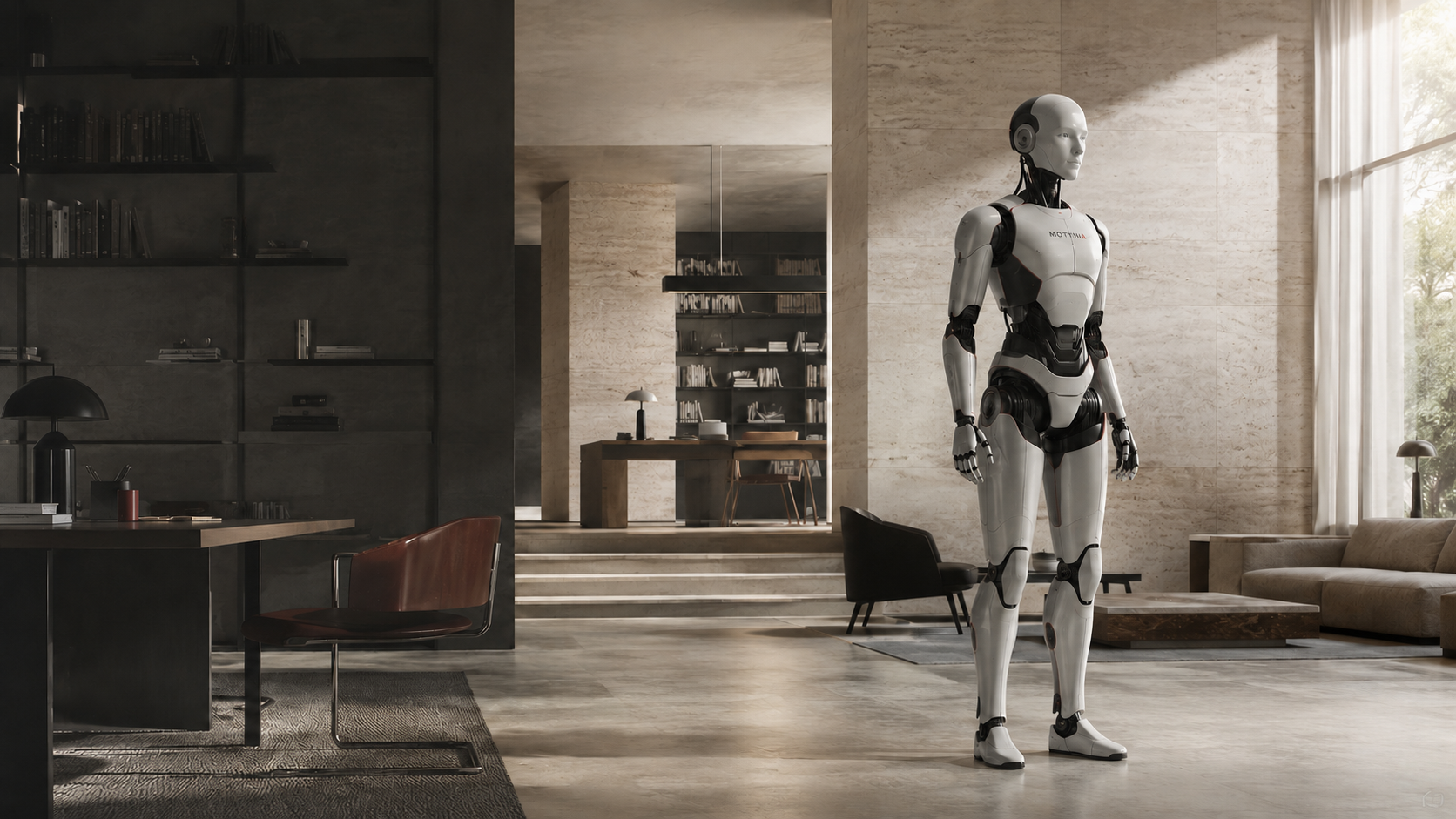
We adapt consumer-grade humanoids for meaningful roles in companies, education, and everyday life—combining applied intelligence with Italian design culture.
Humanoid robots belong in human environments because they understand our spaces, tools, and gestures. The opportunity is no longer to invent another machine—but to make this new class of machine useful, trusted, and beautifully integrated.
MOTYNIA is an R&D initiative building the integration layer between increasingly capable consumer humanoids and the real workflows people want them to perform.
A humanoid robot sees, listens, moves through shared spaces, interacts with people, and connects to critical workflows. Its security cannot be added after deployment.
MOTYNIA integrates cybersecurity throughout the robot’s operational lifecycle—from threat modeling and system hardening to adversarial testing, privacy governance, secure updates, and continuous monitoring.
Our founding team includes internationally recognized cybersecurity experts whose work has helped secure robots from five of the world’s leading industrial robotics companies. Together, they have published more than 50 international technical papers.
We begin with environments designed around people—then adapt the robot, its intelligence, and its appearance to belong there.
Reception, guided assistance, routine operations, workplace orientation, and embodied access to company knowledge.
Interactive tutoring, STEAM laboratories, language practice, accessibility support, and safe hands-on exploration of embodied AI.
Structured household tasks, reminders, telepresence, companionship support, and safer independent living—designed around consent and control.
We work above the hardware layer, turning general-purpose humanoids into systems shaped for a specific place, task, and community.
We analyze hardware, software, connectivity, data flows, human permissions, third-party integrations, and physical behavior. Each deployment is threat-modeled, hardened, tested, monitored, and maintained as its responsibilities evolve.
Task analysis, orchestration, knowledge connections, role boundaries, and human escalation paths.
Voice, gesture, movement, timing, and spatial behavior tuned to feel legible—not theatrical.
Materials, color, soft components, accessories, and visual language developed to fit the environment and brand.
On-site setup, staff training, operating protocols, performance review, maintenance coordination, and iteration.
Clear capability limits, supervised autonomy, auditability, predictable failure behavior, and context-specific safeguards.
A humanoid is always seen before it is understood. We treat silhouette, movement, material, and expression as functional elements—because trust begins with what a machine communicates before it speaks.
MOTYNIA is assembling pilot partners, research collaborators, and investors who share a practical conviction: humanoids will matter when they become useful in the environments we already inhabit.
Robots operating around people introduce risks that cannot be delegated to a late-stage compliance exercise. MOTYNIA’s founding cybersecurity expertise creates an architectural advantage: security decisions are made while roles, integrations, and deployment models are still being designed.
Each engagement is designed to prove one valuable role safely before expanding.
Map the environment, people, task, constraints, and success criteria.
Define the role, behaviors, integrations, appearance, and safeguards.
Configure on site, train the team, and run a supervised pilot.
Measure utility, trust, safety, and operational fit; then iterate.
Tell us about the environment and the role you want to explore. We will respond with focused questions and a secure path to a first pilot.